
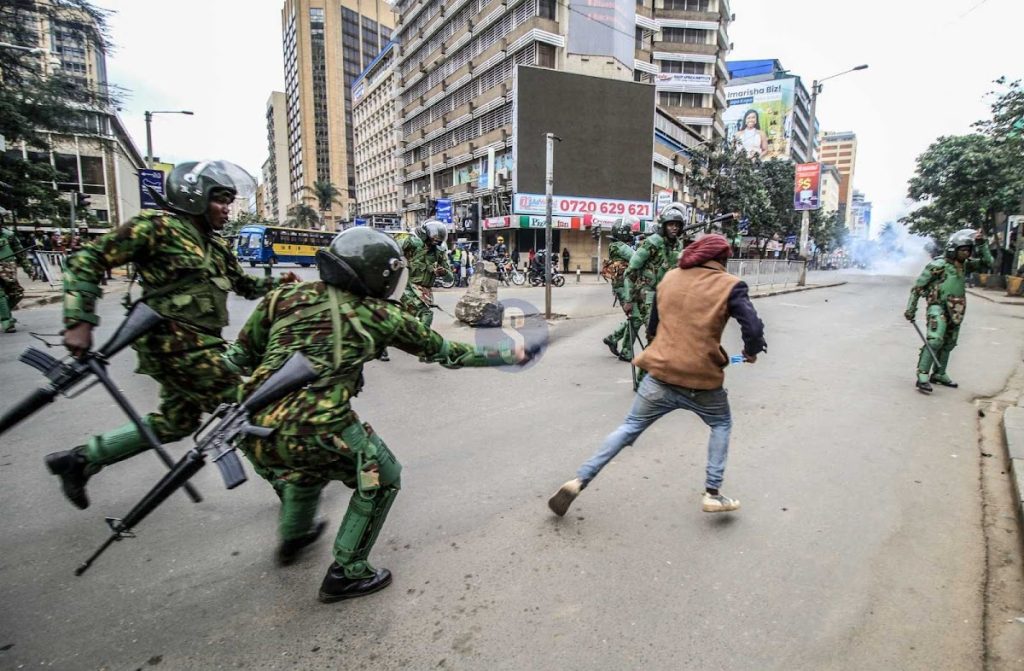
An image depicting Kenyan police officers violently beating a protester in Nairobi. Photo courtesy of The Star Newspaper.
Ah, Kenya! A land rich with promise, a cradle of humanity itself, blessed with sweeping savannas, rolling hills, and vast oceans teeming with life. But beneath the beauty, in the hearts of its restless cities, a different kind of beast prowls. This beast is not born of nature’s bounty, but of power and fear; its name is “The Police.” Clad in uniforms not of bravery but of violence, they are the guardians of the law, but which law, and for whom do they guard it? One might ponder, as the teargas canisters hiss their toxic lullabies into the night, what it means to “serve and protect” when your gun is aimed at the very people you claim to defend. The Kenyan constitution guarantees the right to protest, Article 37, a shining beacon of democracy, promising every citizen the chance to assemble and express themselves. But, alas! That promise seems as fragile as the teargas, vanishing into the wind with each baton crack or rubber bullet whistle.
The Public Order Act of 2012 sounds noble, with its provisions for peaceful assembly and the authority it gives to police to manage public gatherings. However, in practice, one might question whether this act was written with a pen dipped in ink or blood. Section 5 of the Act stipulates that protests may be dispersed only when there is “imminent danger.” But oh, the dangers the regime imagines! They see dangers lurking in the raised fists of workers asking for bread, in the chants of youth seeking justice, in the faces of mothers crying for peace. And so the police, ever eager to obey, turn the tools of the state into weapons of war against their kin. To “restore order,” they say. Ah, but what order? The order of silence? The order of subjugation? When the National Police Service Act of 2011 sought to reform the police and instill discipline and accountability, perhaps it forgot to include empathy. For in the eyes of the police, the protester is not a fellow citizen, a man or woman to whom they are bound by the same flag. No, the protester is a criminal, a thug, a looter, an enemy. And enemies are not reasoned with; they are crushed.
How did we get here, dear Kenya? Where did the promise of freedom and dignity go? Perhaps we must look to the history of the colonial police state, where force was the language of governance, and repression was its syntax. From the 1922 massacre of over 100 protesters demanding the release of Harry Thuku to the independence-era crackdowns and now to the anti-tax protests of today, the baton has passed, but it has not changed its weight. It is still heavy with violence. But what is this violence? The Service Standing Orders say that force must only be used to “disperse a riotous mob.” And so, the police, in their infinite wisdom, seem to find riots everywhere: at the market, in the streets, and even in the homes of the poor. Perhaps it is easier to see riots when one views the world from behind a visor, shield in hand, the clatter of rubber boots drowning out the cries of the people.
And what of the Independent Policing Oversight Authority (IPOA), that august body meant to hold the police accountable? Oh, they have issued reports, fine reports! In 2016, they decried the profiling of protesters, urging that the police should not see every gathering as a threat. They called for a policy on public order management, for training in negotiation and de-escalation. Wise words, indeed. But like whispers in a hurricane, they have been swept away, forgotten in the rush to maintain “order.” Let us not forget the international models that Kenya could emulate. The “negotiated management model” used in the UK and the US comes to mind; where the police work with protesters, where the right to dissent is respected, where dialogue is preferred to batons. Kenya tried it once, or so the history books say. But the police, ever so unaccustomed to conversation, found that the sound of bullets was more to their liking. The attempt failed, leaving behind the scent of unfulfilled potential.
But let us take a step back, dear reader, and reflect on the philosophical question that haunts these streets of Nairobi, Kisumu, and Mombasa: Who is the real criminal? Is it the protester demanding that their children have food to eat, that their taxes not crush their backs? Or is it the officer executing orders with the precision of a machine but without the heart of a human? And if the officer is merely a tool of the state, then is it not the state itself, the regime, the government, that wears the blood on its hands? In his infinite wisdom, President William Ruto praised the police for their “defence of Kenya.” One wonders, what Kenya is he defending? The Kenya of mansions and motorcades? Or the Kenya of slums and struggle? The Kenya, where a handful of elites dine on plenty while the masses go hungry? Perhaps in the eyes of the state, the defence of this Kenya is paramount, and those who challenge it are nothing but enemies of progress. It is ironic, is it not? That the government claims to protect the people from disorder, even as it sows the seeds of chaos with its brutality.
And so, the cycle continues. Protests rise, demanding justice, and the police descend, delivering violence. The people cry out for accountability, and the government offers none. The laws: the Public Order Act, the National Police Service Act, the Service Standing Orders: are mere words on paper, honoured more in breach than in observance. And the IPOA, with its recommendations gathering dust, can do little more than watch as history repeats itself. What, then, is the answer? Should we, as some might suggest, descend into anarchy, casting off the shackles of law and order to create a new world from the ashes of the old? But anarchy is no solution; it is merely another form of violence that devours itself. No, the solution must lie elsewhere. Perhaps in reform, yes. But not the reform of laws, for laws without justice are but words. We need a reform of the soul, a recognition that the police, the protesters, and the politicians are all human, bound by a shared fate.
Let us imagine, for a moment, a future where the police are not the hammer and the people, not the nail. Where the National Police Service Act of 2011 is not just a document gathering dust in a drawer but a living, breathing code that shapes the actions of every officer in the field. Where the ethos of service, of protection, and humanity is more than just words etched into the police crest, it becomes a guiding light, a sacred vow. Picture this: a protest begins in Nairobi’s bustling streets, not with fear but with dialogue. The police, trained in the art of de-escalation, arrive not in armoured trucks but on foot, without the trappings of war. They are there not to disperse but to listen, not to shoot but to safeguard. The Public Order Act of 2012, with its guidelines on using force, is invoked only as a last resort. And the Service Standing Orders? They are no longer seen as a carte blanche for violence but as a call to uphold the sanctity of life.
In this imagined future, the Independent Policing Oversight Authority (IPOA) does more than issue reports. It becomes a true guardian of justice, holding rogue officers accountable and ensuring that no blood is shed without consequence. Imagine an IPOA that is feared not by the people but by the corrupt within the police force, an IPOA that stands as a beacon of accountability, with teeth to punish and a heart to protect. But this vision, as beautiful as it is, seems distant, does it not? For the Kenya we live in today is far from this dream. The Kenya of today is one where, despite the efforts of IPOA, police brutality persists. Where the regime still treats dissent as treason, where force is the first language of governance, and where justice feels like a distant echo in a canyon of violence.
Nevertheless, we must ask ourselves: What will it take to bridge the gap between this dream and our reality? Is it merely a matter of changing laws? No, for we have seen that laws, without the will to enforce them, are hollow. Is it a matter of changing governments? Perhaps, but regimes come and go, and the baton remains heavy. No, the change must be deeper, it must be within us. The police, we are told, are agents of the state. But they are also human beings, sons and daughters of Kenya, with families, hopes, and fears. Why, then, do they turn their backs on their own people? Why do they become the instruments of oppression instead of the shields of freedom? Perhaps it is because they, too, are trapped in a system that dehumanises them just as it dehumanises the protesters they face. Perhaps, in the end, the police are as much victims of the state’s brutality as the protesters they tear gas.
Imagine, then, a police force that is not feared but trusted. A police force that sees itself not as an army against its people but as a part of the community it serves. This is not a utopian dream. It is a reality in many parts of the world, where police officers work with protesters to ensure their safety and where demonstrations are seen not as threats but as the lifeblood of democracy. In countries like Norway, New Zealand, and Canada, the police are known for their restraint and their commitment to human rights. Why not in Kenya? This is where the heart of the problem lies. The police in Kenya are not trained to see themselves as protectors of the people but as enforcers of the regime. They are told that order is the highest good, but the order they defend is one of inequality, oppression, one that benefits the few at the expense of the many. Until this changes, until the police see themselves as agents of justice rather than of power, nothing will change.
And yet, even as we call for change, we must confront the uncomfortable truth: the police are not the root of the problem. They are merely the visible face of a deeper rot. The real issue lies in the structures of power that define what “order” means. In a society where wealth and privilege are concentrated in the hands of a few, where the poor are treated as expendable, it is no wonder that the police see protests as threats. In such a society, any challenge to the status quo is dangerous, and those who defend it are rewarded. This is why President William Ruto can thank the police for their “service” even as bodies lie in the streets. This is why police officers are rarely held accountable for their actions. They are simply doing what they have been trained to do: protect the regime, no matter the cost. And as long as the government defines order as the absence of dissent, violence will remain the preferred tool of the state. But here, too, we must be careful. It is easy to demonise the police, to paint them as villains in this tragic story. But they are not the only ones who have failed. We, the people, have also failed. We have failed to hold our leaders accountable and to demand that our rights be respected. We have allowed the culture of impunity to fester, to become the norm. And now, as we reap the whirlwind, we are left wondering: Who is to blame?
Ah, Kenya, where the baton swings with more authority than the constitution itself, and bullets become the punctuation marks in every conversation about justice. We are all complicit, they say; after all, it takes a village to build this magnitude of brutality. But don’t fret, for redemption lies somewhere between a tear gas cloud and a broken promise. The police march, not to the beat of justice, but to the rhythm of regime loyalty, as the rest of us sit on the sidelines, wondering how long we can watch the heart of our nation bleed and still expect it to keep beating. Perhaps we’re all waiting for that magical day when we stop being enemies and start acting like the family we’ve long forgotten we are. Until then, let’s enjoy the show; it’s only democracy on fire.

The sad African life should I call it
But we shouldn’t lose our pride