
Introduction
In the annals of modern history, few events have elicited such palpable shock as the devastating events of 7 October. On this day, an intricate tapestry of warfare, cultural significance, and historical backdrop came to the fore as the weeklong Jewish festival of Sukkot[1] culminated and the 50th anniversary of the Yom Kippur[2] War was freshly remembered. Operation al-Aqsa Flood, launched by Hamas and its affiliates, heralded a staggering volley of attacks into Israel’s heartland, deeply affecting both military and civilian landscapes.
This cataclysmic upheaval, followed by Israel’s robust and extensive response, brings us to the precipice of profound moral introspection. As the dust settles, it becomes paramount to interrogate the ethical matrix that we, as a global community, employ to decode the actions of nation-states. When does the line between justified retaliation and disproportionate aggression blur? In the unfolding narrative of the Israel-Hamas conflict, these questions beckon with an immediate and philosophically profound urgency. The events provide an aperture through which we may delve deeper into the ethics of warfare, the sanctity of civilian life, and the moral responsibilities of global powers in the theatre of conflict.
1. The Cost of Retaliation
Retaliation, a term often used to justify responses in the realm of geopolitics, has historically operated under the guise of proportionality and necessity. Yet, in the wake of Operation al-Aqsa Flood, Israel’s countermeasures, under the moniker Operation Iron Swords, have necessitated a deeper examination into the nature of this principle. The vast expanse of Israel’s reprisals, not merely regarding military strategy but its ramifications, becomes a focal point of scrutiny.
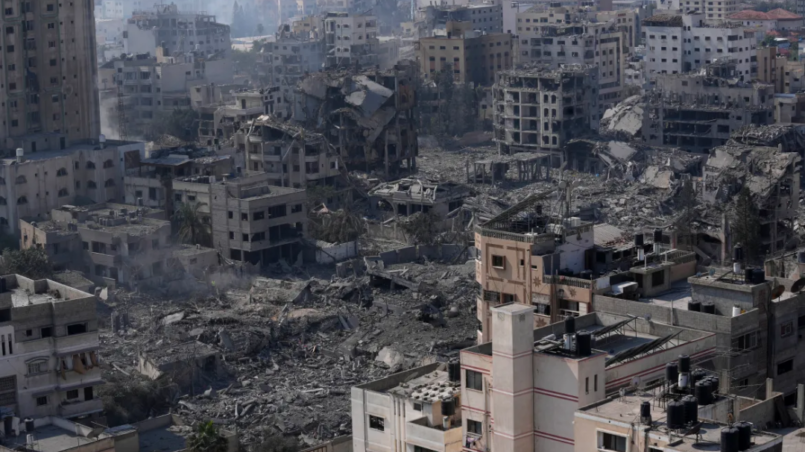
The sheer magnitude of Israel’s response encapsulates military installations, alleged combatant sites, and vital civilian infrastructure. Residential edifices, marketplaces, and centres of faith, mosques have borne the brunt of these operations, rendering the boundaries between military necessity and civilian safety increasingly tenuous. The doctrine of jus in bello (justice in war), a cornerstone of just war theory, posits that actions in warfare should be just and fair. However, when the smoke from the rubble of civilian habitats ascends skyward, the ethical underpinnings of such actions come under the spotlight.
Furthermore, the plight of the non-combatants in this melee cannot be understated. Civilians, often deemed the collateral in the great game of war, found themselves squarely in the vortex of conflict. The destruction of essential amenities and the reported blockade on food, fuel, and electricity paint a grim tableau of a populace besieged by artillery and the exigencies of daily survival. Here, the philosophical inquiry beckons: To what extent can a state’s security apparatus justify its actions at the expense of civilian well-being? And where does the boundary lie between the pursuit of security and the potential descent into collective punishment?
From Aristotle to Arendt, the nature and costs of retaliation have been dissected and debated in the annals of philosophical discourse. As the shadows of Operation Iron Swords loom large, it becomes incumbent upon scholars, statespersons, and the global citizenry to reengage with these timeless questions, seeking answers in a world where the rules of engagement are ever-evolving.From Aristotle to Arendt, the nature and costs of retaliation have been dissected and debated in the annals of philosophical discourse
2. The Ethics of Targeting Civilian Infrastructure
When warfare trespasses the realms of military engagement and encroaches upon the sanctity of civilian infrastructure, the foundational tenets of ethical warfare are inevitably called into question. The deliberate targeting of residential complexes, bustling markets, and places of healing like hospitals transcends mere tactical considerations, ushering in a profound moral quandary. At the heart of this issue lies the principle of distinction, a cornerstone of the jus in bello framework, which mandates a clear demarcation between combatants and non-combatants. By virtue of this precept, civilian infrastructure must remain inviolable irrespective of the provocations or strategic imperatives. However, the obliteration of homes, the decimation of marketplaces, and the ruin of health centres present a stark deviation from this principle, prompting an urgent reflection upon the ethical moorings of such decisions.
Equally perturbing is the imposition of a blockade, effectively stifling the ingress of essential commodities such as food and fuel and severing the lifeblood of electricity from an already beleaguered populace. Beyond the tactical ramifications, this blockade becomes emblematic of a larger philosophical conundrum: Can the collective punishment of an entire populace ever be justified based on immediate exigencies and the quest for security or retaliation? Such measures tread perilously close to infringing upon the fundamental human rights to sustenance, health, and dignity. Indeed, the Universal Declaration of Human Rights enshrines the right to a standard of living adequate for health and well-being, a tenet seemingly at odds with the realities unfolding on the ground.
Drawing from the wellsprings of philosophical thought, from Kant’s categorical imperative to Rawls’ veil of ignorance, one is compelled to evaluate actions not just based on immediate exigencies but through a more expansive lens of universal human dignity. As the dust from the demolished edifices rises, so does the clarion call for a return to the foundational ethics that ought to guide human interactions, even in the most testing of times.
3. The Dilemma of Proportionality
In the extensive tapestry of ethical warfare, few concepts are as pivotal yet as enigmatic as proportionality. Historically anchored within the lexicon of just war theory, proportionality emerges as the moral compass guiding the permissible extent of force in retaliation. It demands of belligerents a calibrated, measured response, ensuring that the force employed is commensurate with the initial transgression. Yet, as the reverberations of Operation Iron Swords permeate the geopolitical landscape, the boundaries of this principle are rigorously tested, prompting an intricate philosophical introspection.
The doctrine of proportionality, deeply rooted in jus in bello, obliges combatants to ensure that the harm inflicted during war, especially to civilians, is proportionate to the military advantage sought. It serves as a bulwark against the excesses of warfare, ensuring that the scales of conflict do not tip perilously towards wanton destruction. Yet, when confronted with the vast scale of Israel’s retaliatory operations, questions burgeon: Can the extensive targeting of civilian infrastructure, the resultant civilian casualties, and the ensuing humanitarian crisis be viewed proportionate to Hama’’ initial onslaught?
Navigating this moral maze necessitates an incisive analysis of both the scale and nature of the initial assault. With its staggering salvo of rockets and ground incursions, Operation al-Aqsa Flood undoubtedly posed significant threats to Israeli sovereignty and civilian safety. However, does rigorous philosophical engagement and aggression warrant Israel’s extensive countermeasures, especially when such actions precipitate profound civilian suffering? In this contemporary theatre of conflict, these age-old tenets beckon with renewed urgency. As we stand at the crossroads of military pragmatism and ethical imperatives, the discourse on proportionality demands rigorous philosophical engagement and compassionate recognition of the shared human condition, lest warfare devolves into unbridled devastation.
4. The World’s Reaction – Support and Silence
In the vast amphitheatre of global geopolitics, the responses of nation-states to crises often transcend mere strategic interests, revealing deeper philosophical orientations and ethical imperatives. With its profound human and infrastructural ramifications, the aftermath of Operation Iron Swords drew varied reactions from the global community, ranging from overt support to conspicuous silence. This mosaic of responses, emblematic of the intricate dance of international relations, brings to the fore profound questions about the ethical responsibilities of global actors.
Prominent players such as the USA, Britain, and key European nations, whose endorsements or abstentions carry significant weight on the global stage, showcased a spectrum of reactions. Their stances, far from being apolitical, become imbued with ethical import. By lending support, whether tacit or overt, to expansive retaliatory actions, do these nations inadvertently sanction a departure from the principles of proportionality and distinction in warfare? Conversely, does silence or abstention reflect a moral dereliction of duty in the face of evident humanitarian crises?
This intricate tableau also invites a reflection on the role of multilateral institutions, with the United Nations standing as a paragon of global ethical governance. Philosophically, the UN, founded on the principles enshrined in its Charter, shoulders the responsibility to maintain international peace and security and to foster cooperation to solve international economic, social, cultural, and humanitarian problems. Does the institution’s response, or lack thereof, align with these foundational tenets as crises unfold, such as that of Operation Iron Swords?
Drawing from the philosophical wellsprings of thinkers like Rousseau, who envisioned a collective social contract, and Habermas, with his discourse on communicative action, one is compelled to interrogate the nature of global responsibility. In a world intricately interconnected, the moral onus extends beyond borders, demanding of global actors a vigilant guardianship of universal human rights and dignity. As conflict echoes resound, they seek a global ethical consensus recognising shared humanity over divisive geopolitics.
5. Historical Precedence and Recurrence
The annals of history, with their intricate tapestries of human endeavour and conflict, recurrently present episodes where the pendulum of retaliation swings beyond the pale of moral and ethical boundaries. As Operation Iron Swords unfurls its tragic narrative, it inexorably evokes memories of past epochs where the dynamics of retaliation and response teetered perilously beyond the thresholds of just warfare.
Drawing upon the Aristotelian notion of historia as a means to gain knowledge, one can journey back to the Peloponnesian War, where Thucydides’ meticulous chronicles delineate the excesses of retaliation. The Mytilenean Debate, with its initial decree to slaughter the populace of Mytilene, serves as a grim testament to the perils of unbridled reprisal. Similarly, the sacking of Magdeburg during the Thirty Years’ War stands as a chilling reminder of the vortex of devastation that unchecked military responses can unleash.
The 20th century, too, with its technologically augmented warfare, offers profound lessons. The atomic obliteration of Hiroshima and Nagasaki, while strategically justified by some as hastening the end of World War II, remains mired in ethical debates around proportionality and civilian harm. These historical precedents serve not merely as detached events but as resonant echoes, admonishing contemporary actors about the perils of repetition.
Hegelian dialectics, emphasising historical processes and synthesising conflicting ideas, posits that history, while providing lessons, also risks recurrence if its teachings remain unheeded. As we juxtapose the present conflict with historical analogues, the recurring motifs of disproportionate response and civilian suffering become all too evident. In this light, history is not merely a chronicle but a moral compass, cautioning against the cyclical traps of disproportionate retaliation.
In the shadow of these historical episodes, the events surrounding Operation Iron Swords pose pressing questions: Are the annals of history merely repositories of past transgressions, or can they serve as beacons, guiding contemporary actors towards a more ethically congruent path? The philosophical imperative, drawing from the likes of Santayana’s cautionary wisdom about forgetting the past, beckons for a vigilant remembrance and heedful application of history’s teachings in the crucible of present conflicts.
Conclusion
In the vast expanse of human history, where the tumultuous dance of diplomacy and conflict has shaped epochs and civilisations, the events surrounding Operation Iron Swords underscore an urgent, timeless truth: the sacrosanctity of human life. As the echoes of combat reverberate, with their accompanying tales of desolation, they prompt a profound philosophical introspection about the nature and purpose of human coexistence.
Drawing from Kant’s cosmopolitan vision of a world where perpetual peace is the ultimate ideal, an immediate cessation of hostilities emerges as a strategic imperative and a moral obligation. The inexorable toll on civilians, those unsuspecting denizens caught in the crossfire, is a grim testament to the perils of military escalation. Their plight, emblematic of the inherent vulnerability of the human condition, beckons for a return to the diplomatic table, where dialogue and mutual respect can forestall the spectre of further devastation.
Yet, the philosophical discourse extends beyond the immediate theater of conflict. In the corridors of global power, where the stances of world leaders shape the contours of international relations, a moral reckoning is afoot. The principles enshrined in international humanitarian law, from the Geneva Conventions to the Hague Regulations, stand not merely as legal codicils but as profound ethical mandates. They call upon global actors to eschew partisanship and to champion the inviolable rights and dignity of every individual, irrespective of nationality or creed.
In the words of Hannah Arendt, the potential for violence resides in the very essence of political action, yet its antithesis, peaceful coexistence, is equally potent. As the world stands at this crossroads, the philosophical imperative is to transcend the cyclical patterns of aggression and retaliation and embrace a shared global harmony vision. It is a vision where the safeguarding of civilians is paramount, where diplomacy triumphs over discord, and where the annals of history, rich with lessons, guide humanity towards a brighter, more compassionate future.
[1] Sukkot, often referred to as the ‘Feast of Tabernacles,’ is a significant Jewish festival that commemorates the Israelites’ 40-year journey in the desert after their exodus from Egypt. During this seven-day festival, participants construct temporary shelters called ‘sukkahs,’ symbolising the impermanent dwellings their ancestors used. It’s a time of thanksgiving, celebrating the harvest and God’s protection, with traditions including the waving of the ‘lulav’ (a bundle of branches) and ‘etrog’ (a citrus fruit). The festival concludes with the Simchat Torah, marking the end of the Torah reading cycle and its immediate restart.
[2] The Yom Kippur War, also known as the October War, took place in 1973 and is one of the defining conflicts in the history of Israel. It began when a coalition of Arab states led by Egypt and Syria launched a surprise attack on Israel on Yom Kippur, the holiest day in the Jewish calendar. Caught off-guard, Israel initially faced setbacks but eventually managed to repel the attackers and even advance into enemy territories. The war had profound implications for Israel, leading to shifts in national perception military doctrine, and eventually paving the way for the Camp David Accords and peace treaty with Egypt.

