
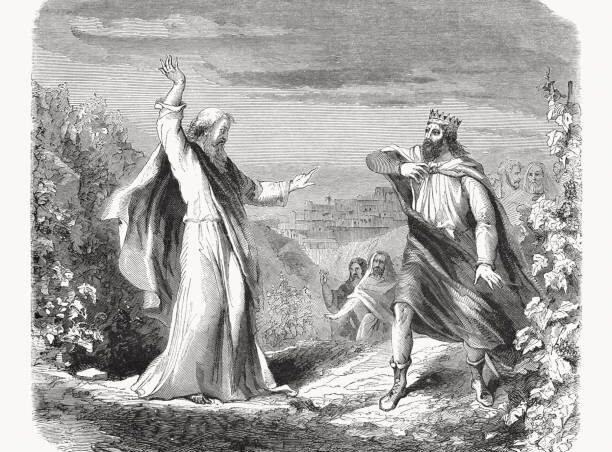
In the labyrinth of the biblical narrative, the ebb and flow of leadership, distinguished by paragons of virtue and tarnished by flagrant desecrators, emerges as a persistent leitmotif. The spiritual pilgrimage of the Israelites, their kaleidoscopic dance with their chieftains, narrates a story of an undulating cycle of submission, defiance, repercussions, contrition, and liberation. This rhythm pulsates with a captivating resonance when juxtaposed with contemporary governance challenges, such as the simmering political convulsions in the heart of Kenya.
Our attention is riveted by the paradigm of King Ahab of Israel, whose life and times are inscribed in the sacred parchment of the First Book of Kings. Ahab’s tenure on the throne was characterised by an audacious dismissal of divine decree and a rampant embrace of idolatry. The echoes of his wayward governance reverberate today in the form of alien deities smuggled into the sacred sanctuary of Israelite worship, flouting the explicit prohibitions from the divine. Ahab’s saga is a parable of governance gone awry, inflicting severe fallout upon the populace. It stands as a grim testament to the divine reaction to collective disobedience manifested through the questionable actions of their ruler.
One might venture into the realms of metaphorical and metaphysical discourse to draw a parallel between Ahab’s saga and the contemporary Kenyan political maelstrom. The saga of Ahab might be regarded as a cosmic tableau, mirroring a divine and human drama that re-enacts itself in different geographies and times. The transgressions of Ahab expressed through his disregard for divine law and the subsequent imposition of alien gods, could be interpreted as a symbol of leaders who, in their pursuit of power or personal interests, disregard the mandate, values, and cultural heritage of their people. In the context of Kenya, these could be leaders who dismiss democratic principles or disregard human rights, compromising the socio-political fabric of the nation and inflicting a profound sense of betrayal and disempowerment upon the populace.
Furthermore, the divine retribution that descended upon Israel in response to the collective disobedience under Ahab’s rule could serve as a metaphysical warning for contemporary societies. A nation’s moral decay or socio-political corruption, often reflected through its leadership, may invite worldly and cosmic consequences. The societal turbulence, political unrest, economic disparity, or environmental degradation experienced today could be seen as the modern embodiment of divine retribution.
In the contemporary Kenyan landscape, the governing body helmed by President William Ruto has found itself ensnared in the throes of public criticism. Once perceived as a beacon of moral clarity and spiritual leadership, the administration appears to have exchanged its compass of virtue for a regimen of policies that inflict hardship upon the common people. The economic burden, soaring to alarming heights fueled by increased taxation, has stirred public disillusionment that resonates with the historical echoes of Israelite discontent under Ahab’s reign.
Voices of dissent rise from opposition quarters, only to dissipate into the air, seemingly unheard by the powers that be. This situation bears an eerie resemblance to the prophets of old, their cautionary cries drowned in the hubris of King Ahab. Protests surge like waves through the streets of Nairobi and other urban hubs, birthing chaos in their wake. It is as though Kenya, caught in this tumultuous storm, is yearning for the emergence of a modern-day Elijah, who might stand against the contemporary “Baal” of economic tribulation and apparent governmental apathy.
In the grand biblical narrative, King Ahab’s reign reached its inevitable conclusion, setting the stage for his successors to introduce much-needed reforms. However, these changes took root not merely because of a change in leadership but due to a seismic shift in the people’s collective consciousness. Recognising the destructive trajectory of their choices, they deliberately decided to seek divine guidance, choosing to walk the path of righteousness and obedience once more.
We can glean insightful parallels for Kenya’s current predicament by delving deeper into this narrative with our metaphysical lenses. Just as the Israelites under Ahab’s rule experienced hardship due to their leaders’ idolatry and disobedience, Kenyans face their own “idols” through economic hardships and perceived governmental negligence. However, the spiritual journey of the Israelites also offers a beacon of hope, showing that with the awakening of collective consciousness and a recommitment to virtuous principles, a society can effect change and emerge from a crisis stronger and more harmonious.
The voices of dissent, symbolised by the opposition parties and the widespread protests, could be seen as modern-day prophets challenging the ruling regime’s questionable practices. Their call for reform is not unlike the prophetic voices that warned Ahab of the dire consequences of his actions. However, for real change to occur, the metaphorical “deaf ears” of the leadership must regain their ability to hear, and the collective consciousness of society must be awakened.
Kenya’s yearning for a “prophet Elijah” may indeed signal a profound desire for a transformative leader who can challenge the existing status quo and champion a new era of economic stability, social justice, and accountable governance. However, the transformation required is in leadership and the entire societal fabric. It demands the awakening of a collective moral and spiritual consciousness that can recognise the perils of the present path and commit to a more righteous and equitable future.
The Old Testament, in its boundless profundity, offers Kenya a mirror into its soul, reflecting the transformative power of collective consciousness in moulding the future of a nation. The current convulsions of unrest and protests sweeping across Kenya may well be the echoes of this collective soul yearning for a governance of justice, integrity, and prosperity. Such a metaphorical awakening of the nation’s spirit parallels the biblical tumults under leaders who strayed from the path of righteousness.
An essential cornerstone for Kenya’s rejuvenation lies in the unyielding resolve of its civil society, whose continued advocacy for accountability holds the potential to steer the nation towards a new dawn. This metamorphosis also critically hinges on the government’s receptiveness to this public outcry and its adaptability in reshaping policies. As the ancient Israelites found themselves at the crossroads of change, so too do Kenyans today, with the opportunity to reshape their narrative by insisting on governance reflecting the moral and spiritual values they were originally pledged.
In the grand narrative of the Old Testament, we are reminded that even when God allowed flawed leaders to reign, His benevolent connection to His people remained unwavering. This divine touchstone continually invited them back towards obedience and justice. This analogy offers a comforting lens through which to view Kenya’s tumultuous journey today. Amidst the current maelstrom, the emergence of a new era of governance waits on the horizon, a possibility that can only be actualised if leaders and citizens together strive to reignite the ethos of their original commitments, seeking a path of righteousness and unity in governance.
Delving deeper into this metaphysical perspective, one can uncover further parallels between the Old Testament’s leaders and today’s Kenyan government. Just as leaders in biblical times faced divine challenges meant to catalyse positive change, so too might the contemporary leaders’ trials serve to stimulate an awakening of the nation’s collective conscience. Such societal rebirth would begin a transformative era of prosperity, justice, and peace. This journey calls for humility and courage, the former to accept past mistakes and the latter to embark on a new path. Leaders and citizens can chart the course towards a brighter future by actively heeding the people’s voices and aligning their actions with promised moral and spiritual values.
Thus, in the vast cosmic narrative of the Old Testament, a metaphysical map is illuminated, guiding Kenya towards a hopeful tomorrow. Despite present adversities, new daybreak is achievable through a shared commitment to righteousness, integrity, and conscientious governance.
