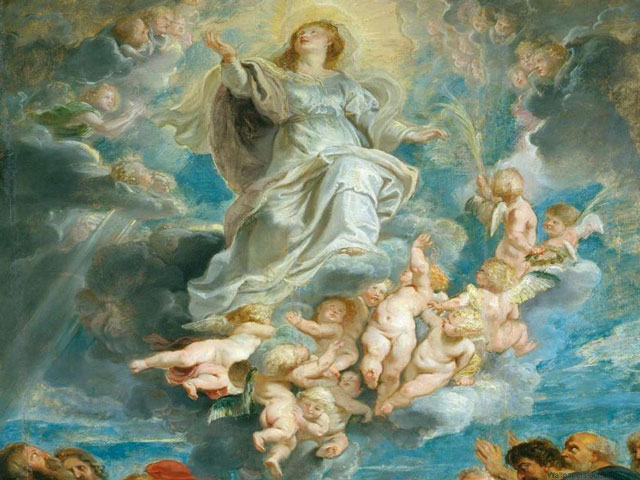
On this day, the Feast of the Assumption of Mary into Heaven, Catholics around the world honour the Mother of God, who was assumed body and soul into heavenly glory. This day is a celebration of Mary’s unique place in salvation history and a profound reminder of her ongoing role as an intercessor for the faithful. As we contemplate the mysteries of her life and her divine Assumption, one event from the Gospels stands out vividly: the Wedding at Cana, where Mary’s intercession led to Jesus’ first public miracle—the changing of water into wine. The account of the Wedding at Cana, as narrated in the Gospel of John (John 2:1-11), is not merely a story of Jesus performing a miracle. It is a profound theological moment that encapsulates Mary’s intercessory role and unwavering trust in her Son. The narrative begins with a seemingly mundane concern: the wine had run out. In the context of a wedding celebration in first-century Jewish culture, running out of wine was a significant social embarrassment, a disaster for the hosts. This moment of crisis prompts the organisers to turn to Mary, who immediately presents the problem to Jesus: “They have no wine” (John 2:3).
At first glance, Jesus’ response might seem puzzling or even dismissive: “Woman, what does this have to do with me? My hour has not yet come” (John 2:4). However, Mary, in her deep understanding of her Son’s mission and in her unshakable faith, does not relent. She turns to the servants and gives a simple yet profound directive: “Do whatever he tells you” (John 2:5). This command is a pivotal moment, highlighting Mary’s role as an intercessor and her understanding of the necessity of obedience to Christ. Mary’s instruction, “Do whatever he tells you,” is a testament to her deep faith in Jesus’ divine mission. It is an acknowledgement that, although His hour had not yet come, she believed in His power and His concern for human needs. This phrase encapsulates the essence of Marian devotion: a call to trust in Christ and to follow His commands without hesitation. Through this statement, Mary directs the attention away from herself and towards her Son, guiding the faithful to place their trust in Him.
The miracle that follows—the transformation of water into wine—serves as a powerful symbol of the new covenant that Jesus would establish. The abundance of superior wine reflects the superabundant grace that Jesus offers to humanity, a grace that is mediated, in part, through Mary’s intercession. In this way, the Wedding at Cana becomes a microcosm of the broader role that Mary plays in the life of the Church: She is not the source of grace, but she is the one who intercedes on behalf of the faithful, guiding them towards her Son and His saving power. This understanding of Mary as an intercessor is deeply rooted in Catholic theology and is often misunderstood by those outside the Catholic tradition. Some non-Catholics accuse Catholics of worshipping Mary or of placing her on the same level as God. However, this perspective fails to grasp the true nature of Marian devotion. Catholics do not pray to Mary instead of God; instead, they ask Mary to intercede on their behalf, to pray with them and for them. Just as one might ask a friend or family member to pray for them, Catholics believe that Mary, as the Mother of the Church, has a special place of honour and a unique role in interceding before her Son.
The Wedding at Cana is a clear example of this intercessory role. Mary does not perform the miracle herself; instead, she brings the need to Jesus and instructs the servants to follow His lead. Her faith and trust in Jesus’ divine mission serve as a model for all believers. By asking Mary to intercede, Catholics are not placing her above Christ but are following her example of trust and obedience, seeking her help in bringing their needs before the Lord. The Feast of the Assumption commemorates Mary’s being taken up into heaven, body and soul, underscoring her unique role in salvation history. It is a reminder that Mary, free from original sin and full of grace, has been glorified in heaven and continues interceding for the Church. Her Assumption is a foretaste of the resurrection that all believers hope for, and it serves as a powerful symbol of the hope and glory that await those who follow Christ. Reflecting on the significance of this Feast and the Wedding at Cana reminds us of Mary’s centrality in the life of the Church. She is not a distant figure but a mother who cares deeply for her children and continually intercedes on their behalf. All Christians are called to emulate her example of faith, obedience, and trust in God.
In conclusion, the Wedding at Cana and the Feast of the Assumption illuminate Mary’s profound role in the economy of salvation. Her intercession at Cana reveals her deep understanding of Jesus’ mission and her unwavering faith in His power. As we celebrate her Assumption, we are reminded that Mary, now glorified in heaven, continues to intercede for us, guiding us to her Son and urging us to “do whatever he tells you.” This is the heart of Marian devotion: a call to deeper faith in Christ, a trust in His divine providence, and a recognition of the powerful role that Mary, the Mother of God, plays in leading us to Him.


Omukuyia ori omuchesi ngana Eshimuna