
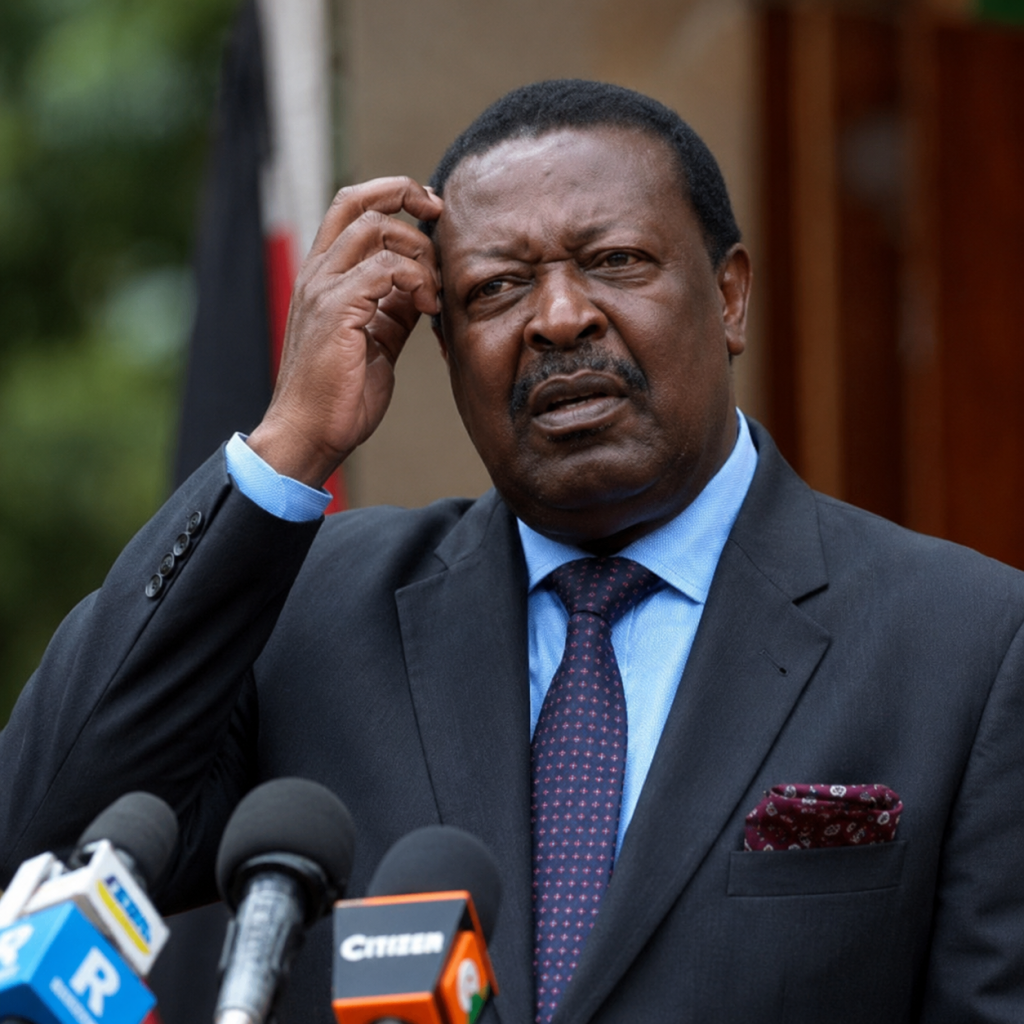
I. A King Without a Party, a Throne Without a Following
There are many ways to commit political suicide in Kenya. You can over‑promise a dual‑carriageway to a hungry constituency. You can pick the wrong color for your campaign merchandise. But Mudavadi has found the most creative method yet: liquidate your own party in broad daylight, hand the rubble to your neighbor, and then insist you are still the undisputed spokesperson for a nation that has never once come looking for you.
Last year, the Prime Cabinet Secretary cheerfully signed the death certificate of the Amani National Congress (ANC), a party that once gave him a platform, seven MPs, a governor, and the only reason anyone in Western Kenya remembered his name. The Registrar of Political Parties confirmed the dissolution in March 2025, following a special delegates’ meeting held a month earlier. With a stroke of a gazette notice, Mudavadi swapped ANC’s luminous green for the beige anonymity of UDA’s waiting room. His supporters called it a “merger”; everyone else called it what it was: a surrender.
When the disgruntled former party members confronted him, they did not mince words: “Musalia, you have betrayed us, and you are one of the leaders we believed would one day become president. Your only work has been to shift parties and use us for your own benefit.” Former Speaker Kenneth Marende, who left the ANC long before it sank, called the move a betrayal of the Luhya community in particular. Others were more biblical. One group of disaffected members measured the price of Mudavadi’s defection in pieces of silver, and they did not mean thirty, they meant every single coin of political credibility the man ever possessed.
II. The Gluttony of a Ghost
What makes the satire so sharp is the timing. At the very moment Mudavadi was handing over the keys to his political house, the Luhya community was openly staging a revolution elsewhere. The Vihiga Council of Elders, tired of waiting for a spokesperson who actually speaks to them, officially endorsed Trans Nzoia Governor George Natembeya as the region’s new mouthpiece. They tasked the former Rift Valley Regional Commissioner with uniting the community ahead of the 2027 elections, a task Mudavadi had spectacularly failed to accomplish during his eight‑year tenure as self‑anointed kingpin.
The irony is thick enough to carve a votive candle from. Mudavadi was appointed the Luhya spokesperson in December 2016, after “research” commissioned by COTU boss Francis Atwoli, a study that apparently did not consult any actual Luhyas. Years later, the crown has not merely been contested; it has been publicly auctioned to the highest bidder for youthful energy. And the highest bidders are not Mudavadi’s aging allies but two men who represent everything he is not: bold, articulate, and refreshingly unafraid of the phrase “thirty pieces of silver.”
III. The Rise of the Unlikely Titans
Enter George Natembeya, the governor who transformed “Tawe” from a two‑letter cry of defiance into a full‑fledged political movement. According to a January 2026 Infotrak poll, 50 percent of Luhya respondents named Natembeya the most influential political leader in the community, ahead of Mudavadi (32 percent) and every other veteran in the region. Natembeya’s power lies in his refusal to play the old game. He does not sit on ceremonial thrones or negotiate secret pacts in five‑star hotels. Instead, he roams the countryside with a bullhorn, telling Luhyas that they have been politically wasted for years and that the time for liberation is now. “You sign an agreement with the President to give us the position of Speaker, then you demand that it goes to yourself, yet once you get it, you move and forget all other people,” he said, aiming directly at Mudavadi and Moses Wetang’ula.
Not far behind him is Edwin Sifuna, the Nairobi Senator who has mastered the art of turning the Senate chamber into a boxing ring. Sifuna, who also happens to be the ODM Secretary General, earned 31 percent in the same Infotrak poll, nearly matching Mudavadi’s score despite holding no grassroots office in Western Kenya. More strikingly, a TIFA survey released in May 2026 found that 44 percent of Luhya community members now recognize Sifuna as their leader, a staggering rise from zero percent just a year earlier. Yes, you read that correctly: Mudavadi spent decades cultivating political networks in the region, while Sifuna spent a few months tweeting and debating in Nairobi, and the crowd still says “Sisi ndio Sifuna.”
IV. The Muliro – Wamalwa Echo: Can Two Youngsters Save a Nation?
Political analysts have begun comparing the Sifuna-Natembeya dynamic to the golden era of Masinde Muliro and Michael Kijana Wamalwa, the last time Western Kenya produced leaders who combined courage with eloquence. The parallel is not mere nostalgia. Natembeya embodies Muliro’s bravery: he openly challenges the old kings, calls Mudavadi a surrenderer of community interests, and asks why anyone would fold a party without consulting a single supporter. Sifuna channels Wamalwa’s articulation: he translates complex national debates into viral soundbites that even the most cynical youth can grasp.
In April 2026, the two met for tea with Vihiga Senator Godfrey Osotsi, sparking rumors of a formal alliance. Sifuna posted on social media: “Catching up with my brothers Osotsi and Governor Natembeya over tea… mbele ni kuzuri sana.” Behind the casual emojis lies a serious calculation: a Sifuna-Natembeya axis could finally break the cycle of elder-driven, fragmented Luhya politics that has repeatedly collapsed at the national ballot. The region has spent nearly two decades since Wamalwa’s death in 2003 chasing unity that never materialized. Now, for the first time, two younger leaders are speaking the language of ideology, accountability, and a truly independent regional agenda.
To be sure, the road to 2027 is full of potholes. Natembeya has at times rejected working directly with Sifuna, preferring to chart his own path. The opposition remains fractured, and Mudavadi’s UDA machinery is not entirely toothless. But something has shifted. The Luhya nation is no longer willing to be a spare tire in the presidential convoy. It wants the steering wheel, or at least a seat at the table. And it is tired of spokespersons who cannot speak, leaders who cannot lead, and kings who sold their parties for the promise of a cabinet portfolio.
V. The Verdict as an Epitaph for a Ghost
So, who is Musalia Mudavadi to speak on behalf of the Luhya nation? The answer, delivered with all the kindness of a satirical dagger, is: no one. He is a man whose political party now lives only in the memory of a gazette notice. He is a spokesperson whose crown has been snatched by a governor who says “Tawe” and a senator who says “Sisi ndio Sifuna.” He is a leader who warned the Luhya community that it would suffer if it made him lose his seat on the National Security Council, a threat that sounds less like statesmanship and more like a hostage video.
In the upcoming general elections, the Luhya nation faces a clear choice. It can continue to follow a man who dissolved his own identity for a plate of lukewarm porridge, or it can embrace a new wave of leaders who remember that a spokesperson’s job is to speak for the people, not at them. If Natembeya and Sifuna can channel their energy into a coherent movement and resist the temptation to turn on each other before the ballots are printed, Western Kenya may finally produce a political earthquake that shakes the entire country.
But even if they fail, at least they will have tried. And that, dear reader, is more than can be said of a man who sold his party for thirty pieces of silver and now worries about what comes next. The Mulembe nation is watching. For the first time, it is not interested in reruns of a political tragedy. It wants a new script.
Tawe.!
