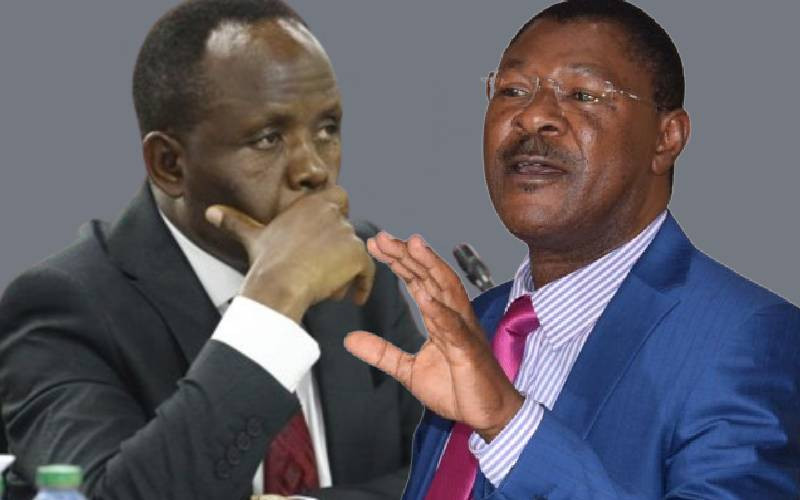
An intriguing battle of influence unfolds in Kenyan politics’ vibrant and competitive arena, particularly in the Western region. Trans Nzoia Governor George Natembeya, noted for his progressive and reformative approach, is stepping into the political limelight, challenging the entrenched power of National Assembly Speaker Moses Wetangula. Natembeya’s impressive resume of changes and active community involvement positions him as a formidable contender, resonating with voters and threatening to diminish the three decades of Wetangula’s sway over the region. This is not just a political shift but a seismic change that could reshape the entire political landscape of Western Kenya.
Tensions have reached a boiling point at a recent funeral in Goseta, Trans Nzoia county, where supporters of Wetangula and Natembeya clashed—a testament to the heightened political stakes. Accusations have flown of leaders rallying their followers, escalating the conflict. This is not just a battle of words but a physical manifestation of the deep-rooted divisions created by this power struggle. Natembeya has taken a firm stand against “the gospel of poverty,” criticising those who preach humility and piety while enjoying luxuries. He argues that it is not enough to promise the electorate a heavenly future; they deserve to experience prosperity in their current lives.
Drawing parallels with Kenya’s past struggles, Natembeya recalls the oppressive Moi era yet reminds his audience of the courageous few who stood up for democracy and freedom, like Masinde Muliro and Jaramogi Oginga Odinga. He questions whether the present-day leaders claiming influence would have shown the same bravery. Moreover, he challenges the narrative that has left the people of Western Kenya diminished and derided, a sentiment he attributes to the leadership of Wetangula and his political allies.
Natembeya’s rhetoric is one of empowerment and change. He rejects the notion of suppression and dominance, epitomised by phrases like “mambo ya kugandamiza.” Instead, he urges his constituents to assert their prosperity, declaring, “Nataka muwe na pesa!”—a call for economic liberation.
Analysing the political landscape, he points out the discrepancy between the claims of dominion by Wetangula’s Ford Kenya party, which holds a mere fraction of parliamentary seats compared to the total in Western Kenya. He challenges the legitimacy of Wetangula’s leadership, highlighting the disparity between the small number of seats his party holds and the more significant political dynamics of the region, where many MPs are not aligned with Ford Kenya or the ANC party. In contrast, other regions in Kenya, such as Nyanza with ODM and Rift Valley with UDA, have clearer political affiliations.
Renowned political analyst Herman Manyora views such contests as the hallmark of a vigorous political ecosystem. The spotlight is on the perceived leadership void in Western Kenya, a topic stirring much discourse in the political corridors.
Why does this vacuum exist when political figures like Musalia Mudavadi and Moses Wetangula are present? According to Manyora, the essence lies in the effective occupancy of the political landscape. It is indisputable, he contends, that figures like Raila Odinga reign over Luo Nyanza, Kalonzo Musyoka commands the Kamba Nation, and Ruto holds sway in the Rift Valley. Meanwhile, in the Central region, a subtle tussle unfolds between Ndindi Nyoro and Gachagua, vying for the reins of leadership.
Amid this backdrop, George Natembeya emerges, boldly staking his claim and chipping away at Wetangula’s foothold. Manyora characterises Natembeya’s approach as a strategic game of political chess, seeking to first outmanoeuvre Wetangula before setting his sights on Mudavadi. His critique of the established figures is pointed and barbed, lamenting missed opportunities and a lack of decisive action.
This allegory of political conquests is not without its moments of satire. Manyora’s commentary suggests a theatrical performance where the old guard is being ushered out, not with a grand finale but with the stealthy advance of a new protagonist. Natembeya’s ascendancy, according to Manyora, is akin to a fresh breeze in a stale room, promising to sweep away the cobwebs of complacency. His rise to power could herald a new era of prosperity and progress for Western Kenya, a prospect that fills the air with anticipation and hope.
In the dynamic theatre of Kenyan politics, National Assembly Speaker Moses Wetangula has masterfully orchestrated his movements with the dexterity of a seasoned thespian. His defection from the allegiance of Raila Odinga to President Ruto’s coalition was a strategic gambit that profoundly altered the political equilibrium in Bungoma, reverberating through the valleys of Trans Nzoia. Wetangula’s campaign to unite the Bukusu vote, despite being met with a discerning electorate wary of political opportunism, represents an ambitious attempt to navigate a treacherous and rapidly changing political landscape. However, his efforts resonate with dissonance among the voting blocs, indicating a discordant response to his political overtures. The controversy surrounding the Housing Levy further complicates Wetangula’s political score, with the Court of Appeal ruling concordance with a lower court to stifle the levy’s imposition, underscoring the critical need for solid legislative underpinnings to such fiscal measures.
Amidst this backdrop, Governor George Natembeya emerges as a formidable presence, reminiscent of a knight brandishing the sword of administrative acumen. Natembeya’s campaign, predicated on tangible achievements and administrative effectiveness, is poised to challenge Wetangula’s long-standing dominion. The contrast between Wetangula’s legalistic manoeuvres and Natembeya’s hands-on approach to governance frames a political contest reminiscent of a classical drama, where the legacy of one’s tenure and the promise of renewed leadership engage in a compelling dialectic. This confrontation sets the stage for a recalibration of political power, with Wetangula’s grasp on his political fiefdom appearing increasingly precarious.
Simultaneously, Nairobi’s Senator Sifuna, with a compelling oratorical skill set, has emerged as a critical player whose influence extends well into the Luhya heartland. His eloquence and political acuity make him a significant force capable of shaping the region’s political narrative. The articulation of his vision has the potential to resonate deeply with the Bukusu community, further establishing his stature as a central figure in Western Kenya’s political dynamics. The speculative synergy of a partnership between Sifuna and Natembeya suggests a new coalition that could harness their respective strengths—Sifuna’s persuasive public dialogue and Natembeya’s governance expertise.
Such a coalition, founded on the precept of charismatic communication and effective policy execution, might herald a reinvigorated political direction, heralding an era of transformation and progress. Together, their concerted efforts could author a new chapter in the political annals of Western Kenya, one that transcends the conventions of traditional political alignments and paves the way for a renaissance of leadership within the Bukusu and beyond. As this potential political alliance germinates in public discourse, it represents not merely a narrative of power but a vision for a unified and prosperous future, waiting for the electorate’s impending curtain call.